
GIRLS ON FIRE RULES
A Quick Guide to Girls on Fire Flag Football Rules
How a game starts
A coin flip or rock–paper–scissors determines which team starts with the ball.
The team with the ball (the offense) begins its first drive at its 5-yard line.
The offense has 4 plays (downs) to move the ball past the halfway line.
What happens if they don’t cross halfway?
If the offense uses all 4 downs and does not cross halfway, the other team takes possession of the ball at its own 5-yard line.
Once a team crosses halfway
After crossing halfway, the offense gets a new set of 4 downs to try to score a touchdown ( a touchdown occurs when a team carries or catches the ball in the opponent’s end zone).
If the offense does not score a touchdown within those 4 downs, the defense takes possession of the ball at its own 5-yard line.
Scoring
A touchdown is worth 6 points.
After a touchdown, the scoring team gets one extra play (called a “PAT” - Point(s) After Touchdown):
1 point if they score from the 5-yard line (the ball must be passed - running plays are not allowed)
2 points if they score from the 10-yard line (running plays are allowed)
The coach chooses either 1- or 2-point PAT
After the PAT attempt, possession switches and the next drive begins at the 5-yard line.
A safety is worth 2 points. A safety occurs when a player is declared down with the ball in her own end zone.
How a play starts
Each play begins with the ball placed on the field at a spot called the “line of scrimmage”.
The offense lines up behind the line of scrimmage, and the defense lines up in front of it.
The play starts when the ball is “snapped” from the center to the quarterback.
At the snap, all players must be set and not moving
Once the referee places the ball, the offense has 20 seconds to snap it.
In general, a play ends when a forward pass is incomplete (not caught), the ball carrier’s flag is pulled, they go out of bounds, or they score a touchdown.
After the snap (running, passing & timing)
After the snap, the offense may run or forward-pass the ball.
The quarterback has 7 seconds to throw or hand off the ball. If the ball is not released in time, the offense loses that down.
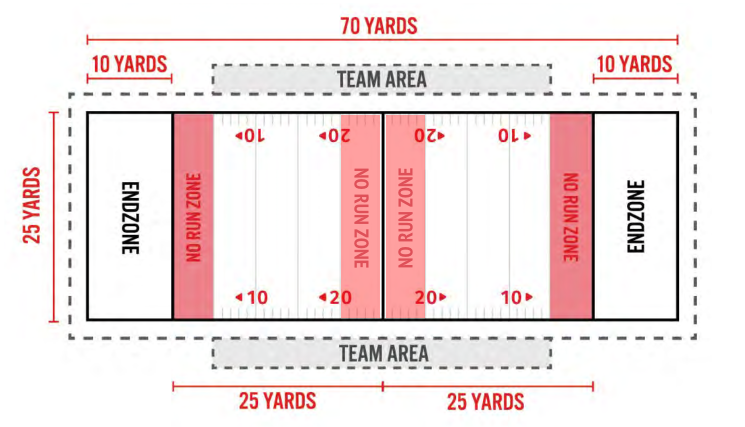
No-Run Zones: When the offense is within 5 yards of the goal line or the halfway line, the ball must be passed - running plays are not allowed.
Defense & Blitzing (Rushing the Quarterback)
A blitz means a defender rushes the quarterback instead of dropping back to cover a receiver.
Spark Division:
Defensive players cannot blitz.
All other divisions:
The defense may blitz once per drive. Only one player may blitz.
The blitzer must start 7 yards behind the line of scrimmage, in a position where the referee can clearly see they are the required distance back.
Game Length, Timeouts & Overtime
Games have two 12-minute halves with a 2-minute halftime.
The clock runs continuously.
Each team gets one 30-second timeout per half.
Regular season games may end in a tie.
In the playoff tournament, tied games are decided by teams taking turns attempting 1- or 2-point PATs until one team wins.
Questions from Coaches
If the defense blitzes, can the QB run?
No, the QB (the player who receives the ball from the center’s snap) cannot run past the line of scrimmage in any situation.
Are fumbles considered a dead ball?
Yes, a fumble is considered a dead ball and results in a loss of down at the spot of the fumble. This includes balls dropped from a lateral or backward pass.
If a team intercepts the ball, do they start their possession from their 5-yard line?
No, an interception results in the team starting their possession from the spot they were downed after the interception. This is the only situation in which a team starts its possession from a location other than its 5-yard line.
How are rankings determined?
Rankings are based on 1) total wins, 2) head-to-head, then 3) point differential (i.e. points for minus points against). So, if your team has the same win-loss record as another team and has a better point differential (e.g. your point differential is +10 and their’s is -5) but you are ranked 4 and they are ranked 3, it is because your team lost in a head-to-head game against them.
One more thing: Only the team captain or head coach may ask the referee questions about rule clarification and interpretations. Players and parents may not question calls.